
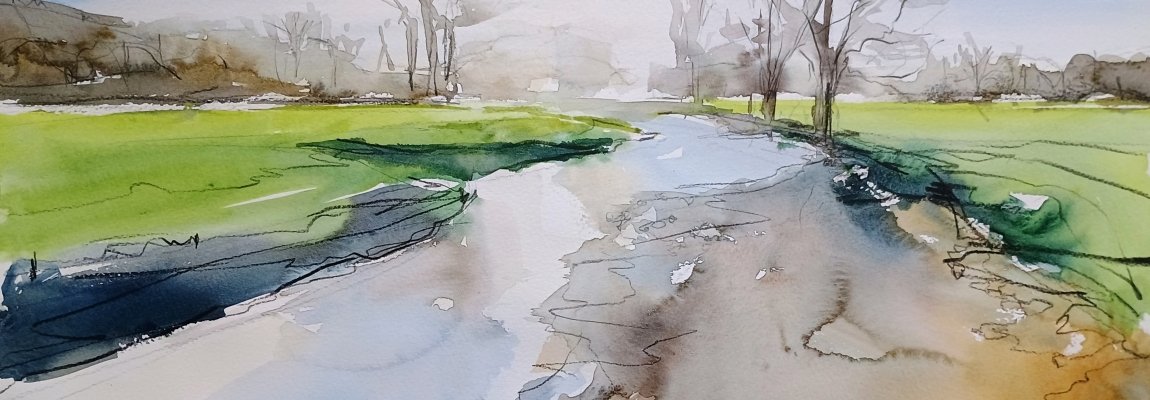
Section of ‘Into the day’, River Coly, Colyton East Devon
Do you ever find that you want to be creative but you stall at the blank sheet of paper? Know you have it in you but can’t seem to begin? You are not alone. Most people who enjoy making art find themselves like this at some point, and it is mega frustrating. So read on to find out all my best ways to get back into the creative zone with minimum delay!
What is creative flow state?
In a nutshell, it’s that sensation of losing yourself in the moment, dropping out of the everyday and accessing something special and personal to you alone – something that isn’t measured on any clock. Time slows and becomes meaningless. All that matters is what you’re focussing on. And let me tell you, it’s a beautiful, wonderful thing.
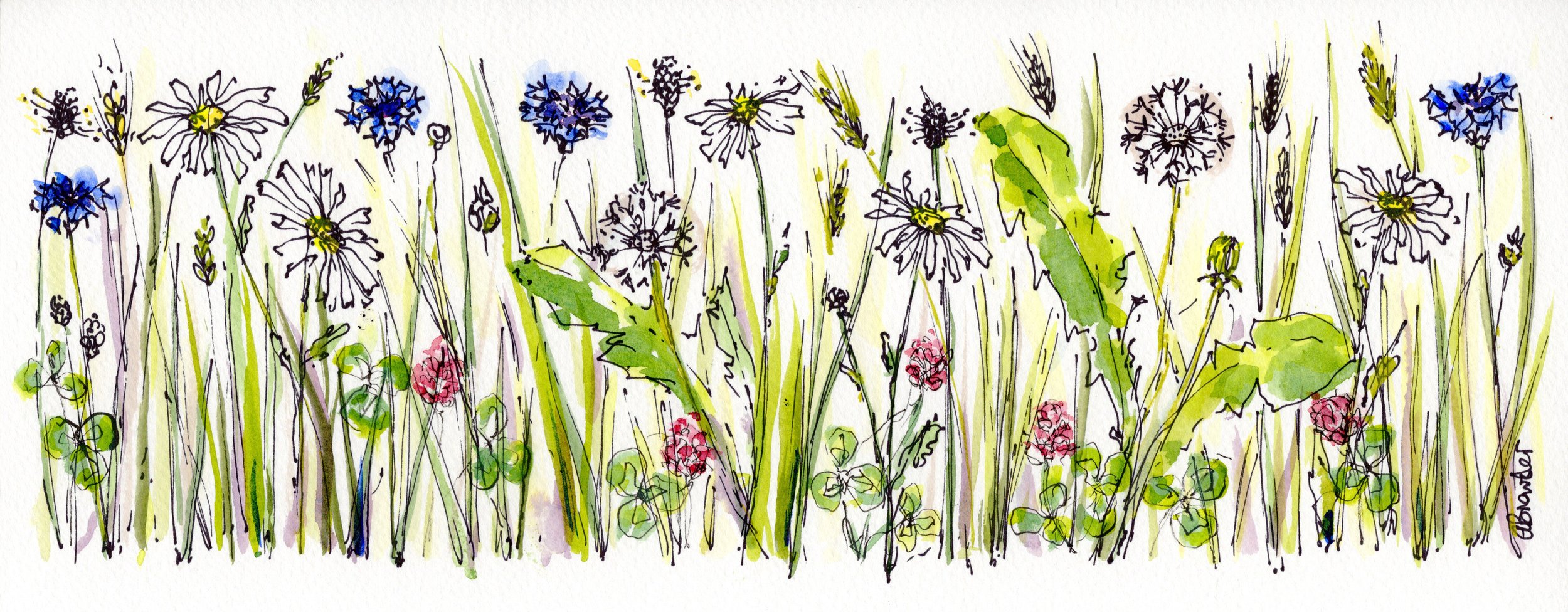
Summer meadow, ink and wash
Why do we need this?
Reflecting on my own art practice, I noticed that I wasn’t leaving room for this slip into creative space, despite doing my best to facilitate that exact same thing for the learners who came to my classes. Was I less important to myself than they were?
Perhaps so – or at the very least I had put my own creative flow needs at the bottom of the pile. Let’s face it, it’s such a massive pile in modern life. Admin, family, home, all the daily stuff that needs to be done.
Even when I was able to carve out the time to paint I was finding that I couldn’t access that calm, focussed state I needed; it was almost that in setting aside the time I was placing too great an expectation on my own ability to rise to the challenge, immediately drop into creative flow and paint a masterpiece. No pressure then…
Guess what? You don’t need a fancy studio to get creative.
I’ve been considering this a lot of late, and also reading Wild Places by Robert MacFarlane, in which he describes the change in his own mindset from seeking out the big wild untouched-by-human spaces, to realising that a truly wild space can be small and exist absolutely anywhere, even in the middle of a city.
This really resonated with me as an artist. We don’t always need the full day in the big fancy studio. Sometimes, five minutes with the back of a beer mat and a biro can be just as good for our creativity and by setting our expectations relatively low, we also reduce pressure to perform – which is usually what opens the gates to awesome creative practice.
So, this one is for all the time-poor folks out there who still need, maybe even crave, a little pocket of creative flow. A toe dipped into the calming waters.
Here are five of my favourite tried and tested five minute flow boosters!
For those who prefer to draw along/paint along, I’ve even made a video, find it here
1. The double blind contour draw
Grab a drawing implement, maybe a pen - doesn’t matter what. Tape down a big sheet of paper and close your eyes.
Pen in dominant hand; find the side of your nose with your other hand’s fingertips.
Start to draw, with your eyes closed, following the contours of your own face. Keep your pen on the paper. Keep your eyes closed. Allow your fingertips to gently move over your own features, recording what you find as lines on your paper.
Breathe slowly, relax into this and draw slowly. Consider it a mini face massage!
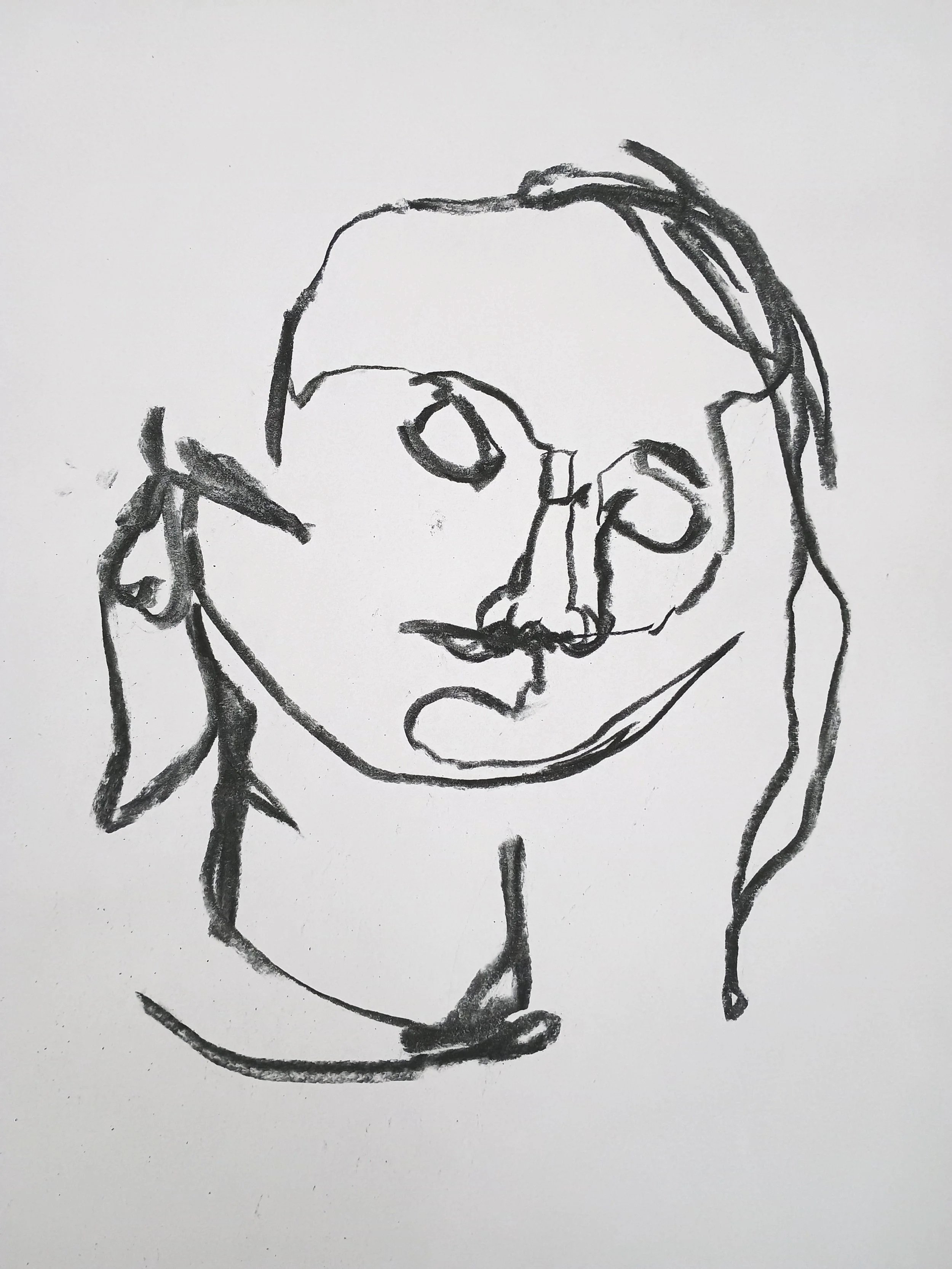
Blind contour drawing example
2. The continuous line
This is similar to the double blind but incredibly versatile. The ‘bag drop’ continuous line is a great place to start, just empty the contents of your bag on the table and draw the lot.
Grab a sheet of paper and a drawing tool, again, it doesn’t matter what but ideally something that moves smoothly over the paper.
Take a handful of items out of your bag, say about seven or eight for starters, and lay them across the top of your paper in a line. It might be easiest if the paper is lying in landscape orientation for this.
Start by drawing a line on to the paper on one side. Then slowly and peacefully, draw each object as your reach it BUT you must keep your pen on the paper the whole time.
You will end up with a wonky drawing with quite a lot of odd lines in it but just moving slowly along the line until you reach the end is incredibly absorbing and can help that drop into that lovely state of creative flow.
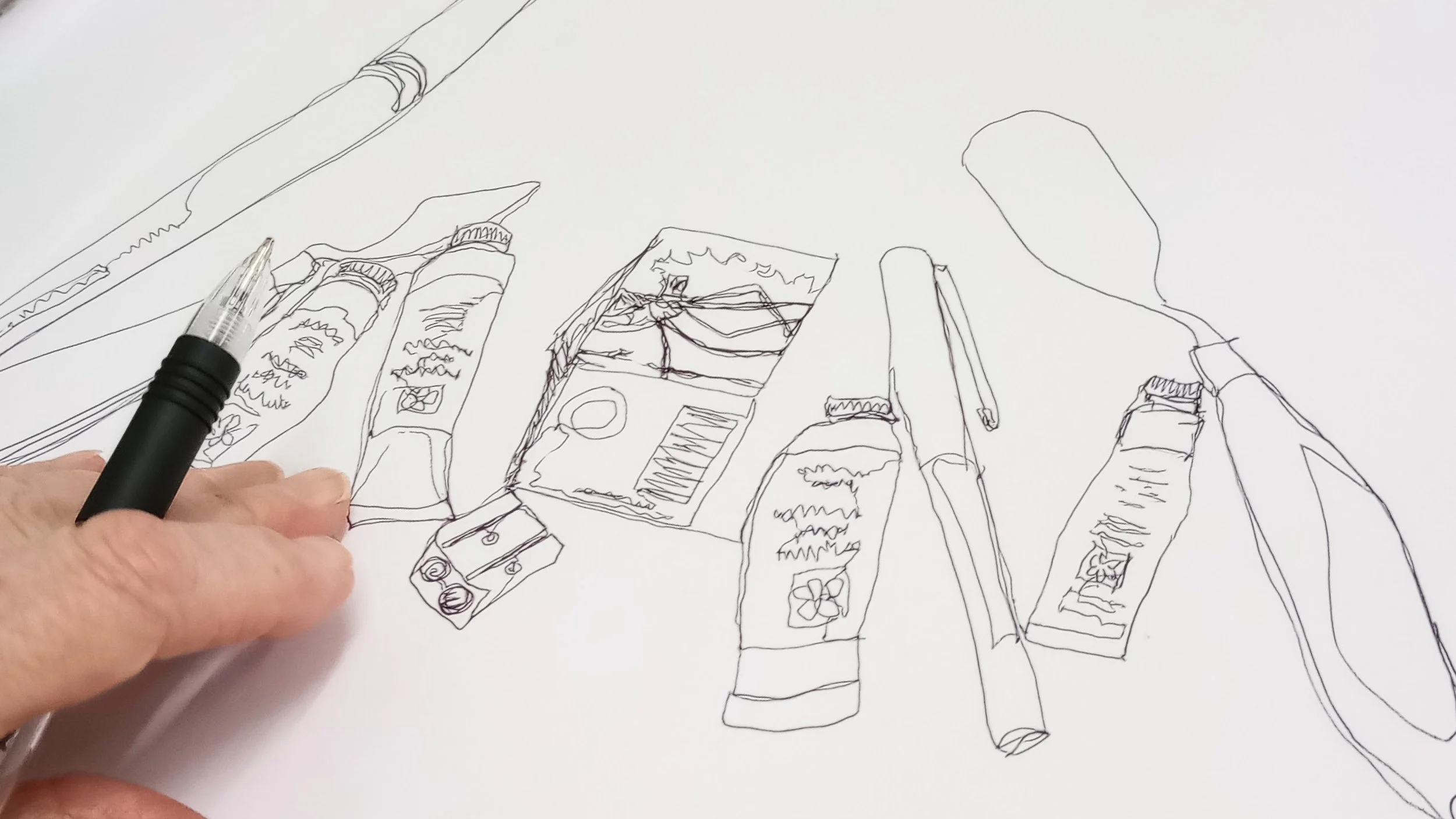
Example of continuous line drawing of art materials by Cathy Badley, at an Art Club session 2024
3. Ombre circles
This one’s for the painters – any paint works well.
Take two colours of paint, preferably very different to each other. Say, red and green, or blue and yellow, or red and blue.
Grab a nice big brush and a piece of paper.
On your paper, paint a circle of one colour, about the size of a large coin. Sweep round with the brush to form the circle, then infill the middle. You’re aiming to do this all with one lovely generous brushload so don’t skimp on the paint!
Add a tiny smidgeon of the other colour to your first colour, just enough to tint it. Paint another circle. Add another tiny smidgeon. Paint another circle.
Keep going until your circles have changed in colour from the first colour to almost the second – then paint one final circle using some clean second colour.
See how many graduations in colour you can achieve. The more the better! Try out different colours too. You might find some combos you love.
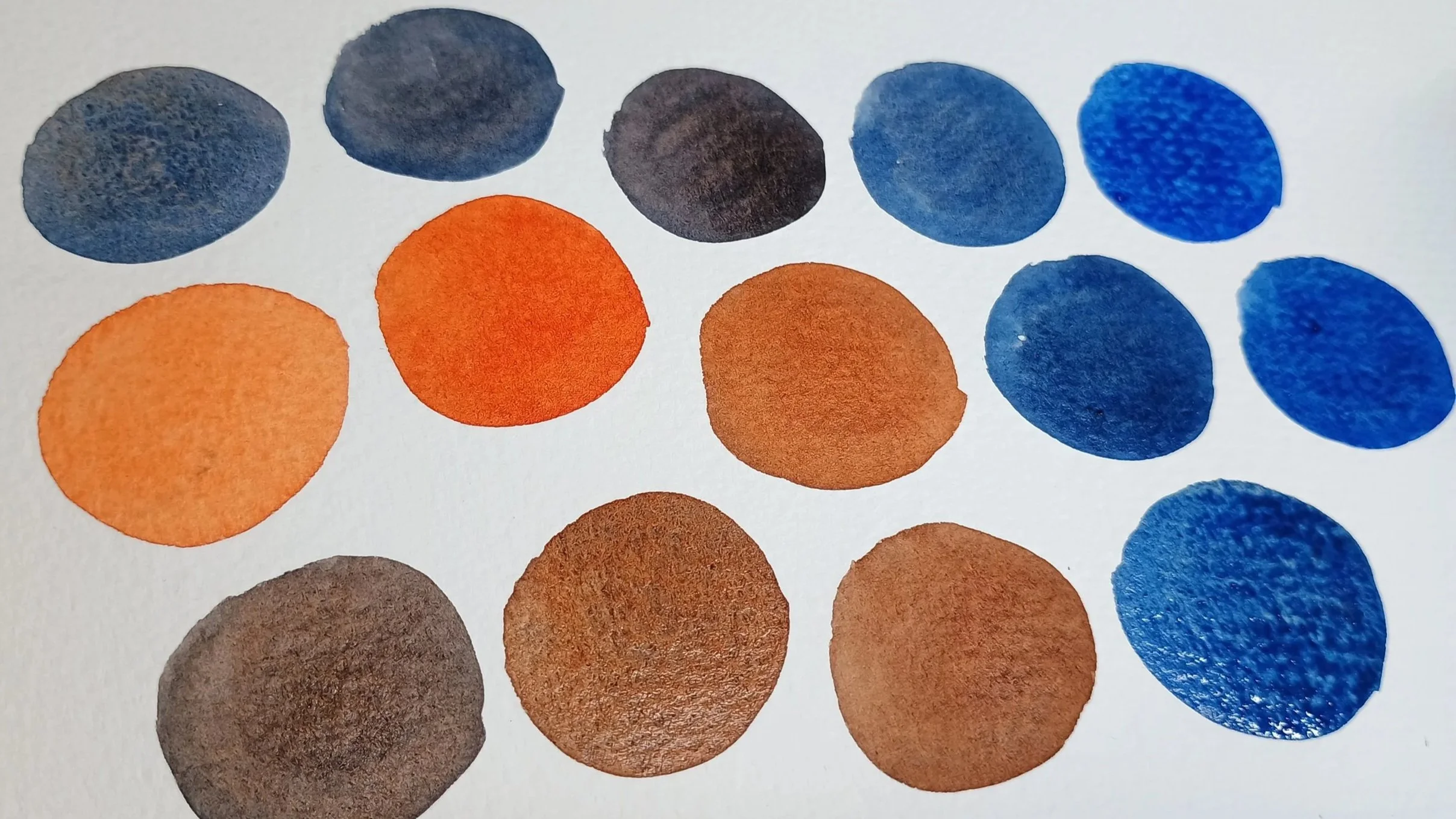
Ombre circles, made with transparent pyrrol orange and french ultramarine blue (both Daniel Smith watercolour paints)
4. Colour matching
This works with any media and is really absorbing.
Find a selection of colourful objects.
Get out the media of your choice, some paper and draw a set of little boxes.
Slowly and mindfully, choose an object and consider the basic colour. Let’s say it is green. Then what type of green is it? Olive? Emerald? Acid lemony green? A warm green with hints of brown or a cool one with hints of blue?
Try and match the colour with your chosen paints/pens/pencils. Once you’re happy with the match, paint in one of the boxes. If you want to, write next to it how you got that colour. See? You’re improving your art practice and finding creative flow all at the same time. Brilliant!
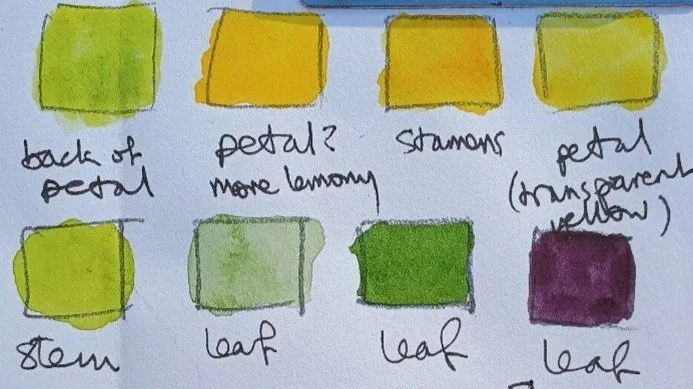
Colour matching with a lesser celandine flower - not just yellow and green!
5. Drawing what you’re hearing (or touching, or smelling…)
One for the nature lovers primarily but this works anywhere with any sounds you are hearing. However, being outside and interacting with nature is great for us human beings so why not combine art and nature for maximum benefit?
Take a pen, pencil or set of coloured pencils, paper and something to rest the paper on outdoors or if the weather’s grim just open a window. Make sure you’ve got somewhere comfy and safe to sit and draw, and this is key, make sure there are birds or other animals or nature sounds nearby – or even urban sounds will do.
Relax. Close your eyes if you’d like to. Just absorb the sounds around you. Feel the breeze, or the sun on your face. Really anchor yourself in this place, in this moment.
When you feel you’ve really put down roots, it’s time to start drawing. Keep your eyes closed if you want or open them, and try and draw the sounds around you. It doesn’t matter what they look like. You’re just observing them and recording them and there is no right or wrong way to do it; just your own way. It might be that certain colours feel nice for certain birdsong, maybe you prefer drawing shapes and not using colour.
Enjoy the connection with nature and your own creativity. For those who prefer to use touch or smell as a guide, try to imagine what things like the fragrance of a rose might look like, or the softness of a dandelion clock!
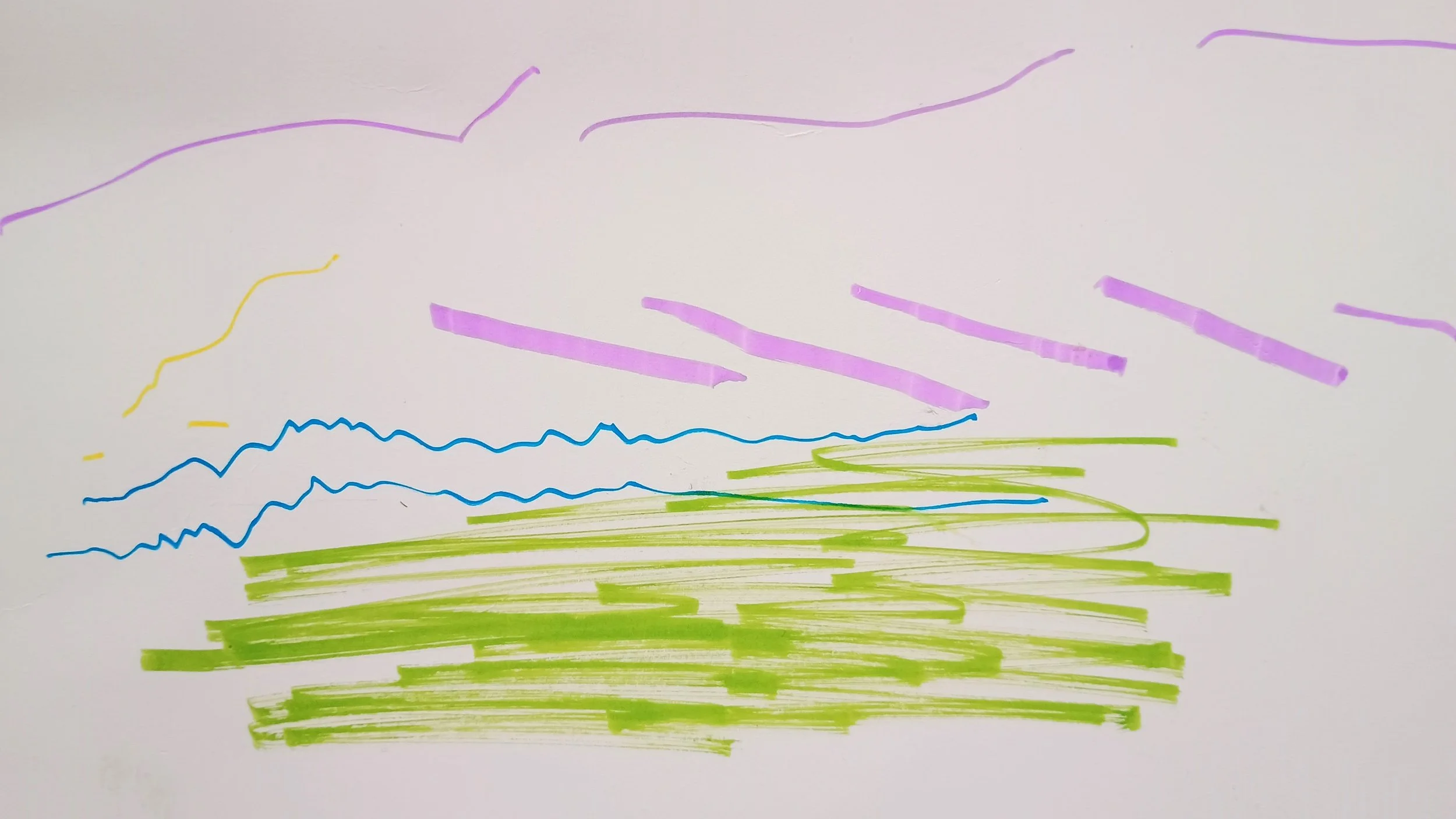
Drawing of various bird songs and wind in the trees
Enjoyed these? Why not check out my YouTube channel, which is packed with fun, easy art project videos to try out at home.